Quick answer
Bring readable weight-bearing knee x-rays, any MRI files, reports, medication lists, and a clear symptom timeline because knee osteoarthritis is diagnosed by matching your story and examination with images, not by an image alone. Send records 2–4 weeks before travel when possible, and plan several business days in Seoul for assessment.
Key takeaways
- Knee osteoarthritis diagnosis depends on your symptoms, physical examination, and weight-bearing x-rays together.
- Original image files in DICOM format are more useful than screenshots or printed films.
- A first consultation in Seoul often needs several business days if new x-rays, MRI review, or translation is needed.
What is the doctor trying to confirm at my knee consultation?
The doctor is trying to confirm whether your pain pattern, knee examination, and images all point to knee osteoarthritis rather than another cause of knee pain. Knee osteoarthritis usually causes pain that builds slowly, such as pain when climbing stairs, standing up after sitting, walking downhill, or taking the first few steps in the morning. Chronic knee pain means pain that persists or comes back for more than 3 months.4
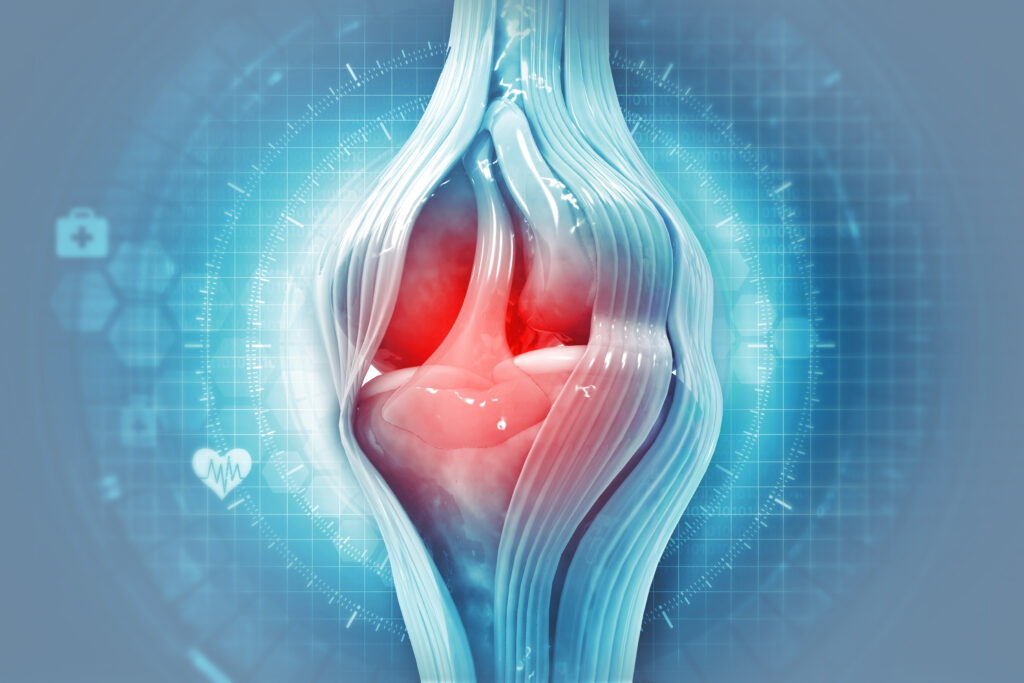
Knee osteoarthritis is not only cartilage thinning; osteoarthritis causes pathologic changes in cartilage, bone, synovium, ligament, muscle, and periarticular fat.1 Cartilage is the smooth, low-friction layer on the ends of the femur, tibia, and patella. Chondrocytes, the cells that maintain cartilage, normally repair the collagen and proteoglycan gel that lets cartilage hold water and spread load.
When chondrocytes are stressed by age, prior injury, body weight, alignment, or repeated overload, chondrocytes release inflammatory signals. Those signals increase enzymes such as matrix metalloproteinases and aggrecanases, which break collagen and proteoglycans faster than the cells can rebuild them. The bone under the cartilage, called subchondral bone, becomes denser, the joint lining called synovium can become irritated, and bony spurs called osteophytes can form at the edges.
A plain analogy is a wet kitchen sponge under a heavy board. A healthy sponge spreads pressure because the water-filled mesh holds its shape. Damaged cartilage loses the mesh that holds water, so load reaches the bone in smaller, harder contact areas.
Which records and images should I bring, and in what format?
You should bring original image files, written reports, clinic notes, and a medication list because the consultation works best when the doctor can compare your symptoms with the actual images. For knee osteoarthritis, the most useful starting images are standing, weight-bearing x-rays of both knees, including front view, side view, kneecap view, and, when available, a bent-knee Rosenberg or similar view. On x-rays, the main osteoarthritis signs are marginal osteophytes and joint space narrowing.1
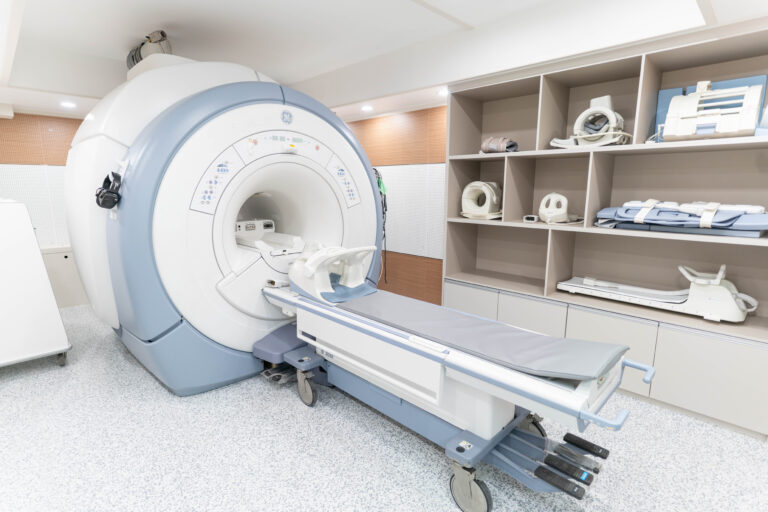
Bring images as DICOM files on a CD, USB drive, or secure download link if your imaging center offers one. DICOM is the medical image format that lets the doctor adjust brightness, measure alignment, and scroll through MRI slices. A phone photo, screenshot, or PDF of one MRI picture is much less useful because the doctor cannot measure the knee or see all slices.
Bring the written radiology reports too, but do not rely on reports alone. A report may say “mild arthritis” or “meniscus tear,” yet the orthopedic examination must show whether that finding matches where you hurt and how your knee moves. Typical clinical osteoarthritis findings may be enough for diagnosis, and medical imaging may be used to improve specificity.4
- Imaging: knee x-rays, MRI, CT, bone scan, or ultrasound files and reports.
- Records: prior orthopedic notes, injection dates, physical therapy summaries, and operative reports.
- Health details: medication list, allergies, major illnesses, blood thinner use, and recent lab results if available.
How far in advance should I arrange the Seoul visit?
You should start arranging the consultation 2–4 weeks before travel when possible because image transfer, translation, scheduling, and travel planning take time. If your pain is stable and you can walk safely, this lead time usually gives the international office enough time to collect records and ask for missing images. If your trip date is fixed sooner, send what you have first and ask which missing items would change the first-day plan.
Before you book flights, ask how the hospital wants to receive large image files. Some imaging centers can give you a CD on the same day, while others need several business days for a medical records request. If you only have printed films, ask the imaging center for the original digital study rather than scanning the printout.
Ask for English copies of key medical documents if available, but do not delay sending records just to make them perfect. A short timeline written by you is often very helpful: when pain began, which side hurts, whether the knee swells, whether the knee locks, how far you can walk, and what happens on stairs. Include exact dates for steroid injections, hyaluronic acid injections, or prior knee arthroscopy (keyhole surgery through small cuts).
You should not use elective overseas travel as the first step if your knee is hot and red with fever, if you cannot bear weight after a fall, or if you have calf swelling, chest pain, or shortness of breath. Those signs need prompt local medical care before travel because infection, fracture, or a blood clot must be ruled out.
What happens on the first day of the orthopedic visit?
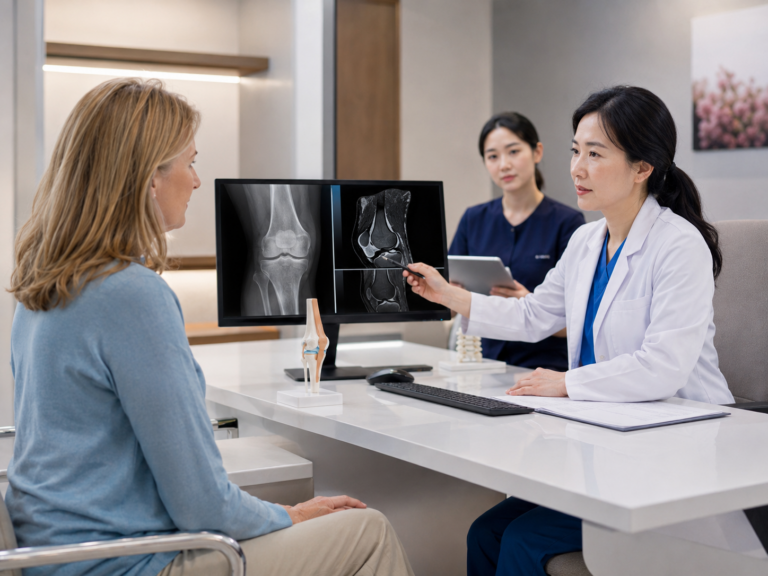
The first day usually focuses on matching your history, physical examination, and imaging so the doctor can make a diagnosis and decide whether more tests are needed. You should wear shorts or loose pants because the doctor needs to see both knees, compare leg alignment, check swelling, and watch how you stand and walk. A standard musculoskeletal and neurological examination is required for diagnosing knee osteoarthritis.4
The doctor may press along the joint line, move the kneecap, bend and straighten the knee, and check the hip and ankle because pain can travel from nearby joints. The examination also looks for bony enlargement, fluid in the joint, loss of full extension, muscle weakness, and nerve findings such as numbness or reflex changes. Bony enlargement is one physical examination finding that is useful in diagnosing knee osteoarthritis.1
If your outside x-rays are missing, not weight-bearing, too old for your current symptoms, or not readable, new standing x-rays may be taken. MRI is not always the first test for knee osteoarthritis, but MRI can help when symptoms suggest another problem, such as a large meniscus tear, ligament injury, bone stress injury, or osteochondral lesion. The diagnosis should also exclude other causes of knee pain, including rheumatoid arthritis, other arthropathies, and infections.4
By the end of the first assessment, you may receive a clear diagnosis, a request for more imaging, or a plan to review outside records after translation. If surgery or injections are discussed, treat that discussion as the start of decision-making, not as something you must decide that same day.
How long should I plan to stay in Seoul for diagnosis?
You should plan at least 3–5 business days in Seoul for a diagnostic consultation, and longer if you already expect added testing or a second discussion after images are reviewed. A single same-day visit may be enough when your records are complete, your images are readable, and your examination matches the x-ray findings. More time is useful when new MRI scheduling, image upload problems, translation, or lab tests are needed.
If you are coming on a long-haul flight, build in one rest day after arrival if you can. Long flights can make a painful knee feel stiffer because sitting slows joint fluid movement and can increase swelling in the lower leg. Gentle walking, ankle pumps, hydration, and using an aisle seat when possible can make the first clinic day easier.
For practical logistics, keep your passport, medication list, and image storage device in your carry-on bag, not checked luggage. Bring enough prescription medicine for the whole trip plus extra days in case of flight changes. If you use a cane, brace, CPAP machine, insulin, or blood thinner, bring the device or medication in its original packaging with the prescription label.
Choose lodging that reduces unnecessary walking on the first few days. Seoul has stairs in some subway stations and hilly streets near some hotels, so an elevator, taxi access, and a short route to the hospital matter more than sightseeing convenience. If you need an interpreter, confirm the arrangement before arrival rather than assuming one can be added at the last minute.
What should I do now before I leave for Korea?
You should now build a complete knee packet and send it before travel because the most useful consultation depends on connecting your lived symptoms with readable images. The controlling point is simple: knee osteoarthritis is diagnosed by the match between the painful knee in front of the doctor and the structural changes seen on proper images. Early-stage knee osteoarthritis is defined in different ways in medical studies, so a label such as “early” or “mild” needs careful review in your own case.3
Write a one-page symptom summary in plain language. Include the painful side, the exact painful area, walking distance, stair problems, morning stiffness time, swelling episodes, locking, giving way, and what medicines or injections helped or did not help. Bring shoes you commonly wear because shoe wear can show walking pattern and leg alignment.
Ask your imaging center for DICOM copies of all knee x-rays and MRI studies, plus reports. Ask your prior orthopedic office for clinic notes, injection records, operative notes, and physical therapy summaries. Send these files through the hospital’s requested channel, and keep a backup USB drive in your carry-on.
Your concrete next step today is to request your original knee image files from every imaging center that has scanned you. Once those files are requested, make your one-page symptom timeline and send both to the international coordination team with your preferred travel dates.
Frequently asked questions
Do I need an MRI before I come for knee osteoarthritis?
You may not need a new MRI before you come if you already have good standing x-rays and your symptoms are typical for knee osteoarthritis. MRI is more helpful when pain seems out of proportion, the knee locks, an injury is recent, or the doctor suspects meniscus, ligament, bone stress, or cartilage problems not clear on x-ray.
Are x-ray reports enough, or does the doctor need the actual images?
The doctor needs the actual images whenever possible because reports summarize findings but do not allow direct measurement or full review. DICOM image files let the orthopedic surgeon assess joint space, osteophytes, alignment, and MRI slices. A written report is still useful, but the report should travel with the image files, not replace them.
Can I come if my knee pain suddenly became severe?
You should seek local medical care first if sudden severe knee pain comes with fever, redness, major swelling, a fall, inability to bear weight, calf swelling, chest pain, or shortness of breath. Those signs can point to infection, fracture, or a blood clot, and those conditions should not wait for an elective international consultation.
How much time should I leave between arrival and my appointment?
One rest day between arrival and the appointment is often helpful after a long-haul flight. Sitting for many hours can increase stiffness and swelling, and jet lag can make a detailed consultation harder. If your schedule is tight, arrive with all records organized and keep the first clinic day free of other plans.
References
- Diagnosis and Treatment of Hip and Knee Osteoarthritis: A Review. JAMA. 2021 Feb 9. PubMed 33560326
- Evidence-based recommendations for the management of anterior cruciate ligament (ACL) rupture. Best practice & research. Clinical rheumatology. 2019 Feb. PubMed 31431274
- A scoping review of how early-stage knee osteoarthritis has been defined. Osteoarthritis and cartilage. 2023 Sep. PubMed 37225053
- 9. Chronic knee pain. Pain practice : the official journal of World Institute of Pain. 2025 Jan. PubMed 39219017
- Osteochondritis Dissecans: Current Understanding of Epidemiology, Etiology, Management, and Outcomes. The Journal of bone and joint surgery. American volume. 2021 Jun 16. PubMed 34109940
- Comparison of robotic-assisted total knee arthroplasty: an updated systematic review and meta-analysis. Journal of robotic surgery. 2024 Jul 25. PubMed 39052153