Published evidence and approvals
Clinical evidence for knee cartilage and osteoarthritis care
One place to see what has been published, what has been approved, and what is still being studied — with links to the original sources and a plain note on what each one cannot tell you.
Request a medical reviewEvidence summary
Published evidence at a glance
The two treatments discussed on this site sit at different points on the evidence scale. One is a same-day procedure supported by small published clinical studies. The other is a manufactured cell therapy approved in Korea and still investigational elsewhere.
| Treatment | Evidence available | Outcome measures | What was reported | Status and limits |
|---|---|---|---|---|
| Bone marrow injection (bone marrow aspirate concentrate, BMAC) | 8 randomized controlled trials (937 patients) pooled in a 2024 systematic review, plus smaller single-group series | Numeric Pain Scale (NPS) Oxford Knee Score (OKS) | Consistent improvement in pain and function from baseline. Against other injections, differences did not exceed the minimal clinically important difference. | An autologous procedure using your own bone marrow, not a licensed drug product. Superiority over placebo or platelet-rich plasma is not established. |
| CARTISTEM® (allogeneic umbilical cord blood-derived stem cell therapy) | Multicenter randomized phase 3 trial against microfracture surgery with 5-year follow-up (114 patients), published in a peer-reviewed journal; market approval in Korea since 2012 | ICRS cartilage grade Histology WOMAC, IKDC, VAS | At 48 weeks, 97.7% improved by at least one ICRS cartilage grade against 71.7% after microfracture (p=0.001). The difference in pain and function was still measurable at 3 to 5 years. | Approved in Korea only; investigational in the United States and Japan. The trial studied older patients with large, full-thickness defects. |
Approval status is country-specific. A treatment approved in Korea is not automatically approved or available where you live, and treatment at our hospital follows the Korean approved indication. Figures above describe groups of patients in published studies and do not predict an individual result.
Bone marrow injection
What the published studies report
Not all evidence carries the same weight. A pooled review of randomized trials tells you more than a single-group series, so the studies below are listed strongest first.
Ranked by strength of study design
| Study | Design | Size | What it found |
|---|---|---|---|
| Han et al., 2024 Orthop J Sports Med | Systematic review of randomized controlled trials | 8 RCTs 937 patients | Bone marrow injection improved pain and function. Compared with other intra-articular injections, differences did not exceed the minimal clinically important difference. |
| Keeling et al., 2022 Am J Sports Med | Systematic review | 8 studies 299 knees | Pain and patient-reported outcomes improved at short- to mid-term follow-up. Superiority over platelet-rich plasma, microfragmented adipose tissue or placebo was not demonstrated. |
| Anz et al., 2022 Am J Sports Med | Randomized trial, bone marrow concentrate vs platelet-rich plasma, 2-year follow-up | 90 patients | Both groups improved from baseline and the improvement was sustained to 24 months. Bone marrow concentrate was not superior to platelet-rich plasma. |
| Shapiro et al., 2017 Am J Sports Med | Placebo-controlled randomized trial (one knee treated, the other given saline) | 25 patients both knees | Pain decreased significantly in both knees, and the difference between the treated and the saline knee was not significant. No serious adverse events. |
| Themistocleous et al., 2018 Heliyon | Single-group series, no control | 121 knees grade 3–4 | NPS 8.33 → 4.49 and OKS 20.20 → 32.29 (p<0.001) at a mean follow-up of about 11 months. |
What this adds up to. Across randomized trials, patients who receive a bone marrow injection consistently report less pain and better function than before treatment. What the trials have not shown is that the injection performs better than platelet-rich plasma, or better than a saline injection, in a like-for-like comparison. Safety has been consistent, with no serious adverse events reported in the trials above. We tell patients this openly, because it is the difference between a treatment that is reasonable to consider and one that is proven superior — and bone marrow injection is currently the first, not the second.
The most frequently cited single study
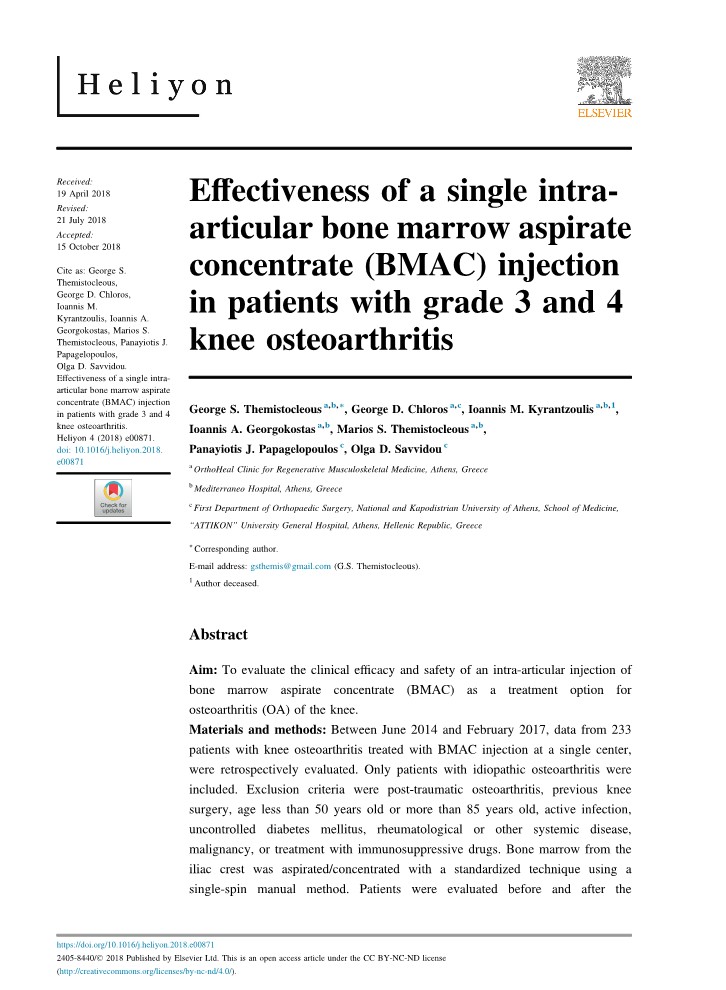
Themistocleous et al., Heliyon 2018 — the published study summarised here (121 knees). Read the full article
Pain and function scores
In 121 knees with grade 3 and 4 osteoarthritis, a single bone marrow concentrate injection was followed by a mean Numeric Pain Scale change from 8.33 to 4.49 and a mean Oxford Knee Score change from 20.20 to 32.29 (p<0.001), at a mean follow-up of approximately 11 months.
Why we do not stop here
This was a single-group series with no control arm. Improvement measured this way cannot be separated from the natural course of symptoms, from rehabilitation, or from placebo effect — which is exactly what the randomized trials above were designed to test.
What is known about safety
An early safety report followed 101 patients treated with same-day bone marrow concentrate for bone healing disorders — femoral head necrosis, avascular necrosis and bone marrow oedema, and non-unions — for a mean of 14 months. No infections, no excessive new bone formation and no tumour formation were reported, and two patients needed further surgery. These indications are not knee osteoarthritis, so the report does not describe how well the treatment works here. What it informs is the safety of harvesting bone marrow and concentrating it in the operating room on the same day.
The harvest itself can cause pain or bruising at the pelvis, and any joint injection carries a small risk of infection and a temporary flare of symptoms. These are reviewed with you before the procedure.
Related, but not the same treatment
A different cell product. Al-Najar et al. (2017) and Vangsness et al. (2014) both injected culture-expanded mesenchymal cells into the knee — the first a phase I/II safety study, the second a randomized, double-blind, controlled study after partial medial meniscectomy. Cells grown in a laboratory over weeks are prepared and regulated differently from bone marrow concentrated in the operating room on the same day.
A different joint, and a surgical adjunct. Hernigou et al. (2014) added bone marrow concentrate to arthroscopic rotator cuff repair in a case-controlled study of 45 treated shoulders against 45 matched controls, and reported higher tendon healing rates and fewer later tears in the augmented group at long-term follow-up. That is tendon repair in the shoulder, not cartilage in the knee.
We list these because they inform the safety and mechanism discussion, not because their results transfer to knee osteoarthritis.
Primary sources
* Source : Han JH, Jung M, Chung K, Jung SH, Choi CH, Kim SH. Bone marrow aspirate concentrate injections for the treatment of knee osteoarthritis: a systematic review of randomized controlled trials. Orthop J Sports Med. 2024 Dec 4;12(12):23259671241296555. PMID: 39640186. doi: 10.1177/23259671241296555
* Source : Keeling LE, Belk JW, Kraeutler MJ, Kallner AC, Lindsay A, McCarty EC, Postma WF. Bone marrow aspirate concentrate for the treatment of knee osteoarthritis: a systematic review. Am J Sports Med. 2022 Jun;50(8):2315-2323. PMID: 34236913. doi: 10.1177/03635465211018837
* Source : Anz AW, Plummer HA, Cohen A, Everts PA, Andrews JR, Hackel JG. Bone marrow aspirate concentrate is equivalent to platelet-rich plasma for the treatment of knee osteoarthritis at 2 years: a prospective randomized trial. Am J Sports Med. 2022 Mar;50(3):618-629. PMID: 35289231. doi: 10.1177/03635465211072554
* Source : Shapiro SA, Kazmerchak SE, Heckman MG, Zubair AC, O’Connor MI. A prospective, single-blind, placebo-controlled trial of bone marrow aspirate concentrate for knee osteoarthritis. Am J Sports Med. 2017 Jan;45(1):82-90. PMID: 27566242. doi: 10.1177/0363546516662455
* Source : Themistocleous GS, Chloros GD, Kyrantzoulis IM, Georgokostas IA, Themistocleous MS, Papagelopoulos PJ, Savvidou OD. Effectiveness of a single intra-articular bone marrow aspirate concentrate (BMAC) injection in patients with grade 3 and 4 knee osteoarthritis. Heliyon. 2018 Oct 18;4(10):e00871. PMID: 30364761; PMCID: PMC6197942. Full text: open access via PubMed Central. doi: 10.1016/j.heliyon.2018.e00871
* Source : Al-Najar M, Khalil H, Al-Ajlouni J, et al. Intra-articular injection of expanded autologous bone marrow mesenchymal cells in moderate and severe knee osteoarthritis is safe: a phase I/II study. J Orthop Surg Res. 2017 Dec 12;12(1):190. doi: 10.1186/s13018-017-0689-6
* Source : Hendrich C, Engelmaier F, Waertel G, Krebs R, Jäger M. Safety of autologous bone marrow aspiration concentrate transplantation: initial experiences in 101 patients. Orthop Rev (Pavia). 2009;1(2):e32. PMID: 21808691. doi: 10.4081/or.2009.e32
* Source : Hernigou P, Flouzat Lachaniette CH, Delambre J, et al. Biologic augmentation of rotator cuff repair with mesenchymal stem cells during arthroscopy improves healing and prevents further tears: a case-controlled study. Int Orthop. 2014;38(9):1811-1818. PMID: 24913770. doi: 10.1007/s00264-014-2391-1
* Source : Vangsness CT Jr, Farr J, Boyd J, Dellaero DT, Mills CR, LeRoux-Williams M. Adult human mesenchymal stem cells delivered via intra-articular injection to the knee following partial medial meniscectomy: a randomized, double-blind, controlled study. J Bone Joint Surg Am. 2014;96(2):90-98. PMID: 24430407. doi: 10.2106/JBJS.M.00058
Limitations to keep in mind
- Improvement from baseline is consistently reported, but superiority over placebo or over platelet-rich plasma has not been established in randomized comparison.
- Preparation methods differ between studies — aspiration site and volume, concentration method, cell counts — so results are not directly comparable across trials.
- Most follow-up is 12 to 24 months. Longer-term durability, and any effect on whether joint replacement is eventually needed, is not established.
- Patient selection — grade of arthritis, leg alignment, body weight, activity level — affects the outcome and differs between studies.
- Published averages describe a group of patients. Results may vary by patient and are not a guarantee of an individual result.
CARTISTEM®
Published evidence and regulatory status
CARTISTEM® is an allogeneic stem cell therapy applied to a cartilage defect during arthroscopic surgery. Unlike bone marrow injection, it has been tested against a comparison surgical treatment in a randomized trial, and the results are published in peer-reviewed journals.
Peer-reviewed evidence
| Study | Design | Size | What it found |
|---|---|---|---|
| Lim et al., 2021 Orthop J Sports Med | Multicenter randomized phase 3 trial against microfracture surgery, with extended 5-year follow-up | 114 enrolled 89 at 48 weeks 73 in the 5-year follow-up | At 48 weeks, 97.7% of the CARTISTEM® group improved by at least one ICRS cartilage grade, against 71.7% after microfracture (p=0.001); histological assessment also favored CARTISTEM® (p=0.036). Between 36 and 60 months, pain and function scores differed significantly between the groups (p<0.05). Reoperation rates were similar (6.0% vs 7.6%). |
| Yang et al., 2022 Knee Surg Sports Traumatol Arthrosc | Comparison against bone marrow concentrate, propensity-score matched, with second-look arthroscopy | 55 vs 55 patients mean 33 months | Pain, function and quality-of-life scores improved in both groups with no significant difference between them. Cartilage regeneration seen at second-look arthroscopy was better in the cord blood stem cell group. |
| Park et al., 2017 Stem Cells Transl Med | Safety and proof-of-concept trial with 7-year extended follow-up | Small cohort KL grade 3, ICRS grade 4 | Cartilage repair assessed by arthroscopy, with pain, IKDC, MRI and histology followed for seven years. Reports the product by name. |
What this adds up to. This is a different level of evidence from bone marrow injection. In a randomized trial against an established surgical treatment, CARTISTEM® produced better cartilage repair, and the clinical difference was still measurable at three to five years. Two points keep it in proportion: the trial studied older patients with large, full-thickness defects, so the result does not automatically transfer to every knee; and better cartilage on arthroscopy does not always translate into a proportionally better result for the patient, as the head-to-head comparison against bone marrow concentrate shows.
Approval and trial status
The milestones below are as reported by the manufacturer, MEDIPOST, and by the public trial registry.
- January 2012 · KoreaMarket approval by the Korean Ministry of Food and Drug Safety (MFDS) for the approved Korean indication. The manufacturer reported that more than 36,000 patients in Korea had been treated as of June 2026.
- May 2026 · JapanThe manufacturer reported that its Japan Phase 3 trial — 130 participants across 13 sites, followed for 52 weeks, with hyaluronic acid as the active control — met its primary and secondary endpoints (WOMAC p<0.0001; ICRS p=0.0002).
- June 2026 · United StatesThe manufacturer reported agreement with the U.S. FDA on a licensing strategy based on a single pivotal Phase 3 trial supported by additional evidence.
- July 2026 · United StatesFirst participant dosed in the U.S. Phase 3 trial (NCT07339111): 300 participants, Kellgren–Lawrence grade 2–3, Outerbridge grade 3–4, cartilage lesions of 2–9 cm², with surgical debridement as the comparison group.
What this does and does not mean. CARTISTEM® is approved in Korea. In the United States and in Japan it is investigational, which means it is still being studied and has not been approved there. An ongoing or completed trial is not an approval, and a reported trial result does not predict a regulatory decision. Treatment at St. Luke’s Hospital is provided within the Korean approved indication, and eligibility is decided only after an individual assessment.
Primary sources
* Source : Lim HC, Park YB, Ha CW, Cole BJ, Lee BK, Jeong HJ, Kim MK, Bin SI, Choi CH, Choi CH, Yoo JD, Yoon JR, Chung JY; Cartistem Research Group. Allogeneic umbilical cord blood-derived mesenchymal stem cell implantation versus microfracture for large, full-thickness cartilage defects in older patients: a multicenter randomized clinical trial and extended 5-year clinical follow-up. Orthop J Sports Med. 2021 Jan 21;9(1):2325967120973052. PMID: 33490296. doi: 10.1177/2325967120973052
* Source : Yang HY, Song EK, Kang SJ, Kwak WK, Kang JK, Seon JK. Allogenic umbilical cord blood-derived mesenchymal stromal cell implantation was superior to bone marrow aspirate concentrate augmentation for cartilage regeneration despite similar clinical outcomes. Knee Surg Sports Traumatol Arthrosc. 2022 Jan;30(1):208-218. PMID: 33492407. doi: 10.1007/s00167-021-06450-w
* Source : Park YB, Ha CW, Lee CH, Yoon YC, Park YG. Cartilage regeneration in osteoarthritic patients by a composite of allogeneic umbilical cord blood-derived mesenchymal stem cells and hyaluronate hydrogel: results from a clinical trial for safety and proof-of-concept with 7 years of extended follow-up. Stem Cells Transl Med. 2017 Feb;6(2):613-621. PMID: 28191757. doi: 10.5966/sctm.2016-0157
Limitations to keep in mind
- The randomized trial enrolled older patients with large, full-thickness cartilage defects. Results in a different type of knee, or a different defect size, may not be the same.
- Better cartilage appearance on arthroscopy does not automatically mean a proportionally better outcome for the patient — in the head-to-head comparison against bone marrow concentrate, clinical scores were similar.
- The treatment is applied during arthroscopic surgery, so recovery and rehabilitation are those of a surgical procedure, not of an outpatient injection.
- Approval is country-specific, and results reported by the manufacturer are not the same as a regulatory decision.
- Results may vary by patient and are not a guarantee of individual results.
How we use it
How to read clinical evidence
Evidence snapshots
Plain-language summaries of the clinical question, what was measured, and what the study could not answer.
Treatment options
Benefits, limitations, risks and alternatives, discussed for your own situation rather than in general terms.
Individual assessment
Research can inform a discussion. A medical decision still requires a direct review by the orthopedic team.
Study design, patient selection, follow-up duration and the outcome measures chosen all affect how a finding should be read. We discuss relevant primary studies, systematic reviews, trial registry entries and regulatory information alongside your imaging, symptoms, medical history and goals. Evidence supports an informed decision; it does not make the decision on its own.
Results may vary by patient and are not a guarantee of individual results.
Questions we are asked
Frequently asked questions
What sources do you consider?
We prioritise primary clinical studies, systematic reviews, public trial registry entries, regulator information and official product documentation. Where a claim rests on a single small study, we say so on this page rather than presenting it as settled.
Why can two studies of the same treatment report different results?
Studies differ in how patients were selected, how the treatment was prepared and delivered, how long patients were followed, what they were compared against, and which outcome scores were used. These differences limit direct comparison between studies and are one reason published numbers should not be read as a prediction.
Does “approved in Korea” mean it is approved in my country?
No. Medical approvals are granted country by country. CARTISTEM® has been approved in Korea since 2012 and remains investigational in the United States and Japan. If you are traveling for treatment, we recommend discussing follow-up care with a physician at home before you decide.
How is evidence used in my case?
It is discussed alongside your symptoms, imaging, medical history, physical examination, goals and the alternatives available to you — including non-surgical care and joint replacement. If the evidence does not support a treatment for your situation, we will say so.
Editorial standards
Medical review and update policy
Medically reviewed by Yeong seok Lee, M.D., Ph.D.
Orthopedic Surgery, St. Luke’s Hospital
Last reviewed: September 2026 · Next scheduled review: March 2027
Clinical content on this site is reviewed by an orthopedic specialist and updated when a material change occurs in the published evidence or in regulatory status. References on this page link to the original publication or trial registry entry so that you can read the primary source yourself.
Next step
Bring your questions to the consultation.
We encourage patients to ask what the evidence means for their own diagnosis, their expected recovery, and the alternatives available to them. If you already have an MRI or X-ray, our team can review it before you travel.
Request a medical review Contact the international patient team