Quick answer
Early signs of knee cartilage damage usually include aching with stairs, stiffness after sitting, swelling after longer walks, and grinding or catching that slowly becomes more frequent. The key point is that early osteoarthritis is not just “wear and tear”; mechanical stress and joint inflammation can overwhelm the cartilage cells that maintain the joint surface.
Key takeaways
- Early knee osteoarthritis starts when cartilage maintenance falls behind cartilage breakdown.
- Pain on stairs, stiffness after sitting, and swelling after use are common early patterns.
- Sudden swelling after injury, fever, a locked knee, or inability to bear weight needs prompt medical care.
What is happening inside my knee if cartilage is breaking down early?
Early knee cartilage damage means the smooth joint surface is losing its normal balance between repair and breakdown. Articular cartilage is the slick white coating on the ends of the femur, tibia, and kneecap. The cells inside cartilage, called chondrocytes, maintain a firm gel-like matrix made mainly of type II collagen and proteoglycans, which hold water and help the knee absorb load.
Osteoarthritis is better understood as progressive cartilage degradation with joint inflammation, not as simple aging of one surface.2 When chondrocytes are stressed by overload, injury, or inflammatory signals, the cells may make less new matrix and release enzymes that cut collagen and proteoglycans. The synovium, which is the thin lining that makes joint fluid, can also become irritated and add more inflammatory chemicals to the joint.
A useful way to picture cartilage is a wet, reinforced sponge with a woven net inside. The collagen net keeps the shape, and the proteoglycan gel holds water. When enzymes cut the net and the gel leaks its water balance, the surface can soften, swell, crack, and transmit more force to the bone under the cartilage.
Why would knee cartilage start breaking down?
Knee cartilage can start breaking down when load, joint structure, and inflammation begin to push the cartilage cells faster than the cells can maintain the surface. Research models describe knee osteoarthritis as a problem that develops when mechanical, biological, and structural factors interact, rather than when one factor acts alone.4 That is why two people of the same age can have very different knees.
Common mechanical triggers include a past ACL tear, a meniscus tear, repeated deep squatting at work, running through pain after an injury, or years of extra load from body weight. The meniscus is the C-shaped shock absorber between the thigh bone and shin bone. After a meniscus injury, altered joint loading can stimulate a pro-inflammatory response that contributes to articular cartilage breakdown.3
Inflammation can also follow a clear injury. Blood inside the knee after trauma can expose cartilage and synovium to heme and inflammatory mediators that may accelerate degenerative change.1 Interleukin-1 beta, one of the inflammatory signals studied in osteoarthritis, can act as an early catalyst for catabolic processes that lead to cartilage breakdown.5 These processes explain why early osteoarthritis can begin long before an X-ray looks severe.
What do the early signs of knee cartilage damage usually feel like?
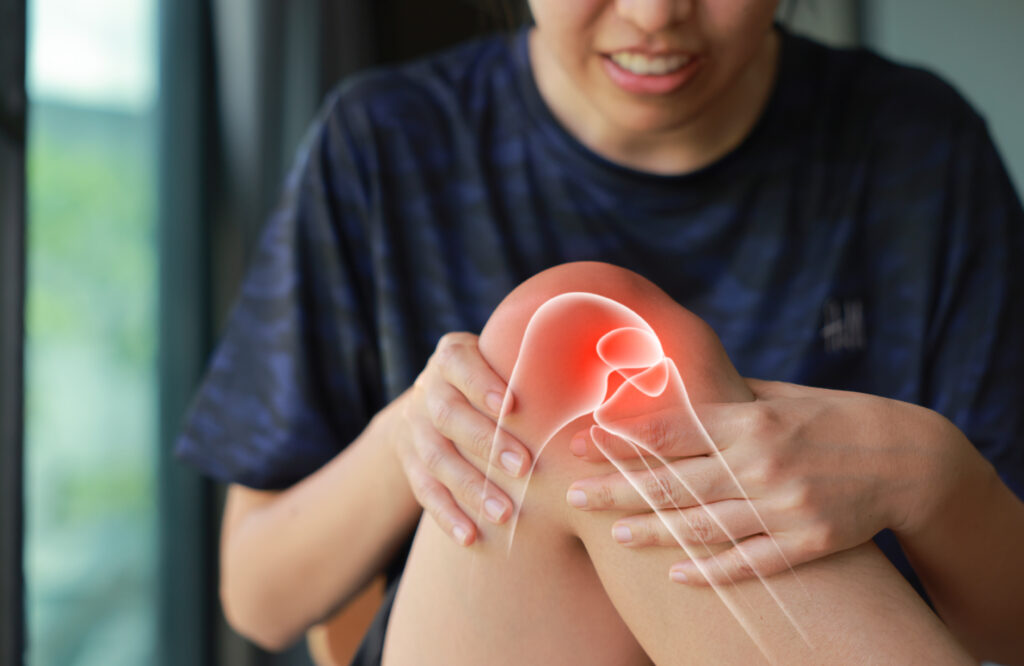
Early knee cartilage damage usually feels like a pattern of load-related discomfort rather than one sharp pain all day. You may notice aching behind the kneecap when going downstairs, soreness on the inner side of the knee after a longer walk, or stiffness when standing up after a movie, a flight, or a long drive. The first few steps in the morning may feel tight, then loosen as joint fluid spreads across the cartilage surface.
Swelling can appear later the same day after hiking, kneeling, tennis, pickleball, or carrying luggage upstairs. The swelling comes from synovial irritation, which increases joint fluid. Grinding, crunching, or a rough feeling can happen when the kneecap and thigh bone no longer glide as smoothly, but noise alone does not prove cartilage damage.
The usual progression is slow and uneven. Symptoms may flare for several days, settle, then return when the knee is loaded again. If a meniscus tear is also present, you may feel catching along the joint line or pain when twisting to get out of a car. Early cartilage damage can still feel mild, so the pattern over weeks matters more than one painful day.
What knee symptoms are not typical for early cartilage damage?
Some knee symptoms are not typical for early cartilage damage and should be assessed promptly. A knee that becomes very swollen within hours after a twist, fall, or sports injury may contain blood, called hemarthrosis. The knee joint is often injured, and injury can lead to a bloody effusion inside the joint.1
You should seek urgent medical care if you cannot put weight on the leg, cannot fully straighten the knee, or feel the knee is locked in one position. A locked knee can mean a torn meniscus fragment or loose body is blocking motion. A hot red knee with fever, chills, or feeling very ill raises concern for infection in the joint, which is different from usual osteoarthritis swelling.
Other warning signs include calf swelling with shortness of breath, severe pain at rest that is getting worse, new numbness or weakness in the foot, or pain after a high-energy injury such as a car crash. These symptoms make you not a good candidate for waiting to see if the pain settles on its own. Early cartilage symptoms are usually uncomfortable, but they should not make you systemically sick or unable to use the leg.
How do doctors assess possible early knee cartilage damage?
Doctors usually assess early knee cartilage damage by matching your symptom pattern, physical examination, and imaging rather than relying on one test. The history often starts with when the pain began, whether there was a twist or fall, where the pain sits, what happens on stairs, and whether swelling appears after walking or sports. Prior ACL injury, meniscus surgery, kneecap dislocation, inflammatory arthritis, and the type of work or exercise you do all change the meaning of the symptoms.
The examination checks gait, leg alignment, knee swelling, range of motion, tenderness along the joint lines, kneecap tracking, ligament stability, and whether twisting tests reproduce catching or pain. The clinician may compare both knees because early loss of extension or small swelling can be easier to notice side by side. Hip and foot motion may also be checked because both can change knee loading.
Standing knee X-rays are often used to look for joint-space narrowing, bone spurs, alignment, and changes under the cartilage. Clinical assessment and plain radiographic imaging can lag behind early-stage osteoarthritis, so a normal X-ray does not always end the evaluation.2 MRI can show cartilage defects, meniscus tears, bone marrow swelling, and ligament injury, but MRI findings must still match your symptoms because many adults have scan changes that are not the main pain source.
What should I do now if I think my knee cartilage is starting to break down?
Your next step is to document the pattern and arrange a medical assessment if symptoms last more than two to three weeks, keep returning, or include swelling. Write down where the pain is, what brings it on, how long stiffness lasts after sitting, whether stairs are worse up or down, and whether the knee catches, buckles, or swells. These details help separate cartilage irritation from tendon pain, kneecap tracking problems, ligament injury, or a meniscus tear.
If you already have an X-ray or MRI report, bring the images and the report, not only a summary. Ask the clinician to explain which structure matches your symptoms: the articular cartilage, meniscus, synovium, bone under the cartilage, kneecap joint, or ligament. That discussion is often more useful than asking whether the knee is simply “worn out.”
The most useful idea to carry forward is that early cartilage breakdown is an active joint process, not just a passive wearing down of age. Mechanical stress and inflammation can change how chondrocytes maintain the cartilage matrix. A clear assessment can show whether your symptoms fit early osteoarthritis, another knee problem, or a warning pattern that needs faster care.
Frequently asked questions
Can early knee cartilage damage heal on its own?
Small cartilage irritation can settle, but true articular cartilage has limited ability to rebuild its original smooth surface. Cartilage has few cells and no direct blood supply, so chondrocytes repair matrix slowly. Symptoms may improve when swelling calms, even if the cartilage surface still has early structural change.
Does clicking or grinding mean I have osteoarthritis?
Clicking or grinding does not prove osteoarthritis by itself. Knees can make noise when tendons move, joint fluid shifts, or the kneecap glides over uneven surfaces. Noise becomes more meaningful when it comes with pain on stairs, swelling after use, stiffness after sitting, or a feeling that the knee catches.
Can an X-ray miss early cartilage damage?
Yes, an X-ray can miss early cartilage damage because X-rays show bone more clearly than cartilage. Doctors infer cartilage loss from joint-space narrowing, but early cartilage softening or a small cartilage defect may not narrow the space. MRI may be considered when symptoms and examination suggest a structure that X-ray cannot show well.
Is early knee osteoarthritis the same as needing a knee replacement?
No, early knee osteoarthritis is not the same as needing a knee replacement. Early disease can mean mild cartilage change, intermittent swelling, or pain only with certain loads. A knee replacement is considered only for later-stage joint damage with severe symptoms after an individual assessment.
References
- A Review of Current Management of Knee Hemarthrosis in the Non-Hemophilic Population. Cartilage. 2021 Dec. PubMed 32698601
- Exploring the Feasibility of Circulating miRNAs as Diagnostic and Prognostic Biomarkers in Osteoarthritis: Challenges and Opportunities. International journal of molecular sciences. 2023 Aug 24. PubMed 37685951
- Biological impact of meniscus injury on post-traumatic osteoarthritis. Connective tissue research. 2025 Sep. PubMed 40223751
- A systems view of risk factors for knee osteoarthritis reveals insights into the pathogenesis of the disease. Annals of biomedical engineering. 2015 Feb. PubMed 25224078
- Exploring the intricate relationship between IL-1β and IL-18 in the context of osteoarthritis. Frontiers in immunology. 2026. PubMed 42564392